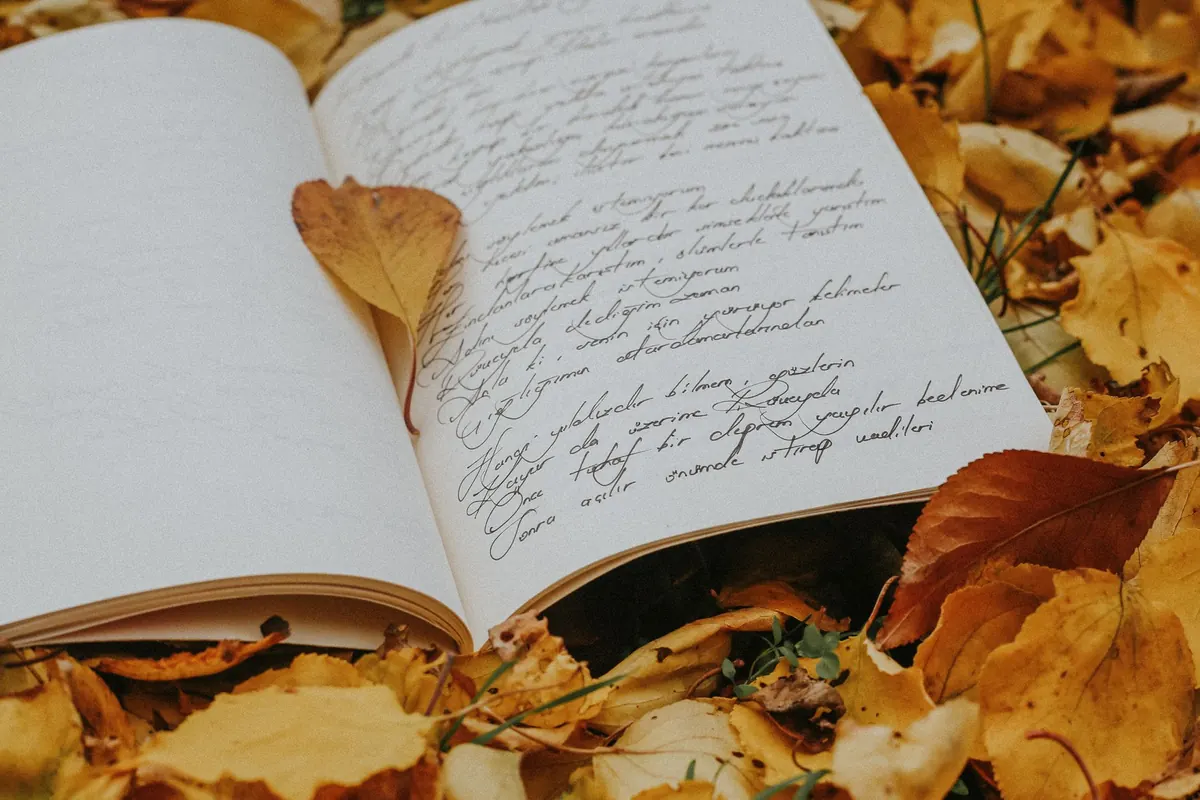
There is a particular afternoon in autumn when the light goes thin and the day ends before you have finished what you meant to do. The garden looks tired. Someone in the house has started wearing a coat indoors. Something in you wants to tidy up, and it is not really about the cupboards.
This is the season for a certain kind of journaling — not planning, not goal-setting, but the quieter work of noticing what has finished and deciding what you will not carry into winter. It takes an evening. It needs a notebook, a pen, and one loose sheet of paper you are willing to give up.
Most of us mark beginnings. We buy a new diary in January, start a course, tell people about a plan. Endings usually happen to us instead: a job winds down, a friendship goes quiet, a health scare rearranges the year, a child leaves home, a routine that held everything together stops working.
Autumn gives that unfinished business a shape. The season is a lesson in visible subtraction — the leaves come off, the evenings close in, the tomato plants go brown in a single cold night. Borrowing that momentum is easier than trying to summon it in June. You are not fighting the mood of the year; you are working with it.
One useful distinction: New Year journaling asks what do I want to become? Autumn journaling asks what is already over, and what am I still pretending isn't? That second question is the one most of us avoid, and the one that makes the first one possible.
If the shorter days bring a low mood that lasts more than a couple of weeks, or that stops you sleeping or eating properly, that is worth raising with a doctor rather than working through alone in a notebook. Journaling is a good companion to care, not a substitute for it.
Choose an evening, not a packed afternoon. Thursday or Sunday works well for many people, partly because the week has already given you something to reflect on and the next day is not frantic. Put the phone in another room. Tell anyone you live with that you are occupied for an hour.
You need less than you think:
If fire is impractical, or you live somewhere with smoke alarms that object, tearing the sheet into small pieces or soaking it in a bowl of water works just as well. The point is the deliberate act, not the flames.
Start with facts, not feelings. Make a plain list of things that finished in the last twelve months, including the small ones. A contract that wasn't renewed. A friendship that faded after one awkward message. The version of your mornings that existed before a schedule changed. A run of good health. A habit you were proud of.
Some items will be obvious. The useful ones tend to be the things you never formally acknowledged — endings that happened without a card or a last day or a conversation.
Then turn to the load. What are you hauling into winter that you no longer need? An old grievance you retell at parties. A project you lost interest in two years ago but keep mentioning. A description of yourself you outgrew — the reliable one, the one who never asks for help, the one who is always about to start something.
Write these as sentences, not single words. "I am still carrying the belief that I should have finished the book by now" tells you more than "guilt".
This is where most attempts collapse: the urge to release everything at once. Choose one item. One. Name it in a single sentence in the present tense, and be specific enough that a stranger would understand what you mean.
I am setting down the habit of checking whether they have replied.
If you cannot choose, pick the item that made your shoulders tighten when you wrote it.
Use two or three. Skip the rest without guilt — a prompt you don't answer is not a task you failed.
For endings:
For release:
Be clear with yourself about what this does and does not do. It does not erase a debt, repair a relationship or undo a loss. It marks a decision you have already made, and gives you a date to remember it by.
Leave the three lines where they are. A week later, read them once and add a single sentence about what you noticed. If the same item keeps reappearing, that is information: some things cannot be released with a ceremony because they need a conversation, a decision, or an apology instead.
And where money, health or legal matters are involved, journaling helps you think clearly — it does not replace proper advice. Speak to the relevant professional. Bring the notebook if it helps you ask better questions.
The full ritual suits a quiet evening twice a year. For the rest of the season, keep a smaller version: three lines before bed on a Sunday — what ended this week, what I am still carrying, one thing I am setting down. Tear out the page, fold it small, and put it in the recycling. Ten minutes, no candle, same effect. Autumn is generous with endings; you do not need to wait for the perfect evening to notice one.
Photo: betül nur akyürek / Pexels

Paper journals win on focus and feel; digital journals win on search and backup. Here is how to choose, or combine...

A commonplace book gathers quotes, ideas, and references into one place, organised by subject rather than by date....
A shorter, later-in-the-day version of morning pages for people whose brains do not come online at dawn — ten...

A free notebook for thoughts and ideas.
