
Somewhere in your phone there is a saved post you have never opened twice. A screenshot of a paragraph that felt important at the time. A line from a book you meant to write down and did not. Most of us collect more than we keep, and the things we keep are scattered across four apps and the back of an envelope. A commonplace book is a low-tech answer to that mess: one place where the words and ideas you want to hold on to actually live.
A commonplace book is a personal collection of passages, quotations, ideas, arguments, references, and useful fragments, gathered as you read and think, and arranged so you can find them again. That is the whole definition. It has no fixed format and no required length.
The habit has a long history. In classical rhetoric, students learned loci communes, the "common places" or general themes from which an argument could be built. By the sixteenth and seventeenth centuries, keeping a commonplace book was a standard part of a European education: you read, you extracted, you filed what you found under headings, and the notebook became a workshop for your own thinking. John Locke even published a short manual on how to index one properly. People have used the method ever since, often for writing, sometimes for sermons, lectures, or just the private pleasure of keeping good sentences near at hand.
What matters now is not the pedigree. It is the shift in behaviour: instead of consuming and forgetting, you copy out what struck you and give it an address.
The confusion is understandable, since both are notebooks kept by one person. But they do different jobs.
A diary is chronological and personal. It moves forward with you: what happened today, what you felt, who said what. Its organising principle is time. You open it at the date.
A commonplace book is thematic and curated. It moves sideways: what you have noticed, learned, and want to use. Its organising principle is subject. You open it at the heading.
In practice the two sit well together. A diary entry might say: "Long walk, argued with my brother, finished the Naipaul." The commonplace book gets the sentence from the Naipaul, copied out in full, filed under "families" or "being a stranger." The diary records your life; the commonplace book records what your life has been feeding on. If you already journal, this is a useful companion rather than a replacement.
Almost anything you would be sorry to lose. The usual contents look something like this:
Two rules keep the collection honest. First, always name the source, even if it is only "novel borrowed from Mum, page unknown." Second, never copy a quotation you have not read in context; the point is to record what a text actually said, not a version of it that flatters you.
Most attempts die in the planning stage. Skip the planning.
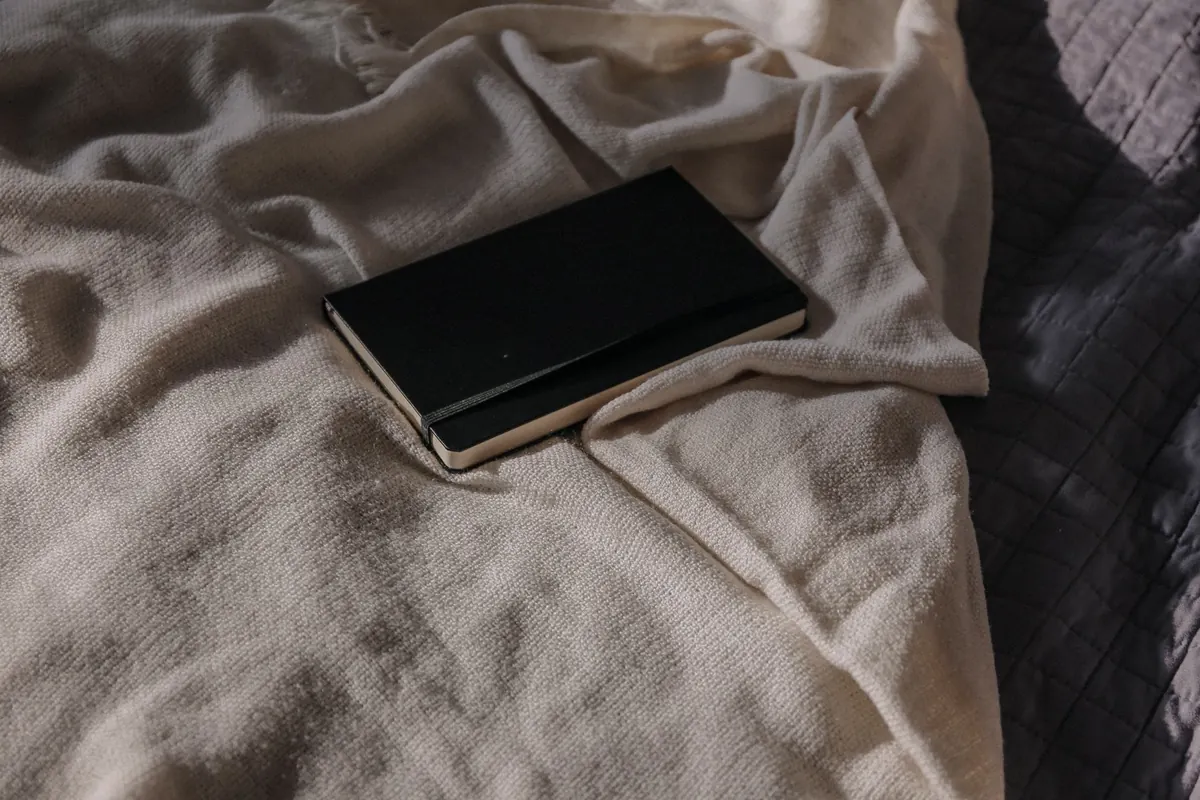
Slow, tactile, and hard to interrupt. Copying by hand forces you to read the sentence properly, which is half the benefit. The trade-off is finding things later. Leave the first few pages blank for an index and number the pages as you go, or just accept that browsing is part of the pleasure.
One entry per card, filed by heading. This is the method that suits people who think in fragments and like to reshuffle: lay the cards out on a table and patterns appear. It is clumsier to carry, so many people keep a small notebook for capture and transfer entries to cards at the end of the week.
Fast to search, easy to back up, available everywhere. Use one document with clear headings, or one file per theme. Resist the urge to build an elaborate tagging scheme in the first month. Search is good enough, and a system you maintain beats a system you admire.
A commonplace book rewards a light touch. Once a week, open it and read a page at random. Add anything you noticed but did not write down: a sentence from a podcast, a line from a conversation, a book you want to find. Then, when you sit down to write something of your own, start by reading three or four entries. That is where the collection pays you back, because you will meet your past reading at the moment you need it.
Keep the bar low. Nine entries a month for a year is a hundred and eight pieces of thinking you would otherwise have lost, and a hundred and eight chances to notice what you actually care about. Begin with one sentence you do not want to forget, write it down properly, and put the book where you will see it tomorrow.

Paper journals win on focus and feel; digital journals win on search and backup. Here is how to choose, or combine...
A shorter, later-in-the-day version of morning pages for people whose brains do not come online at dawn — ten...
Scattered notes don’t have to stay scattered. This guide shows how to gather fragments, find the week’s center, and...

A free notebook for thoughts and ideas.
