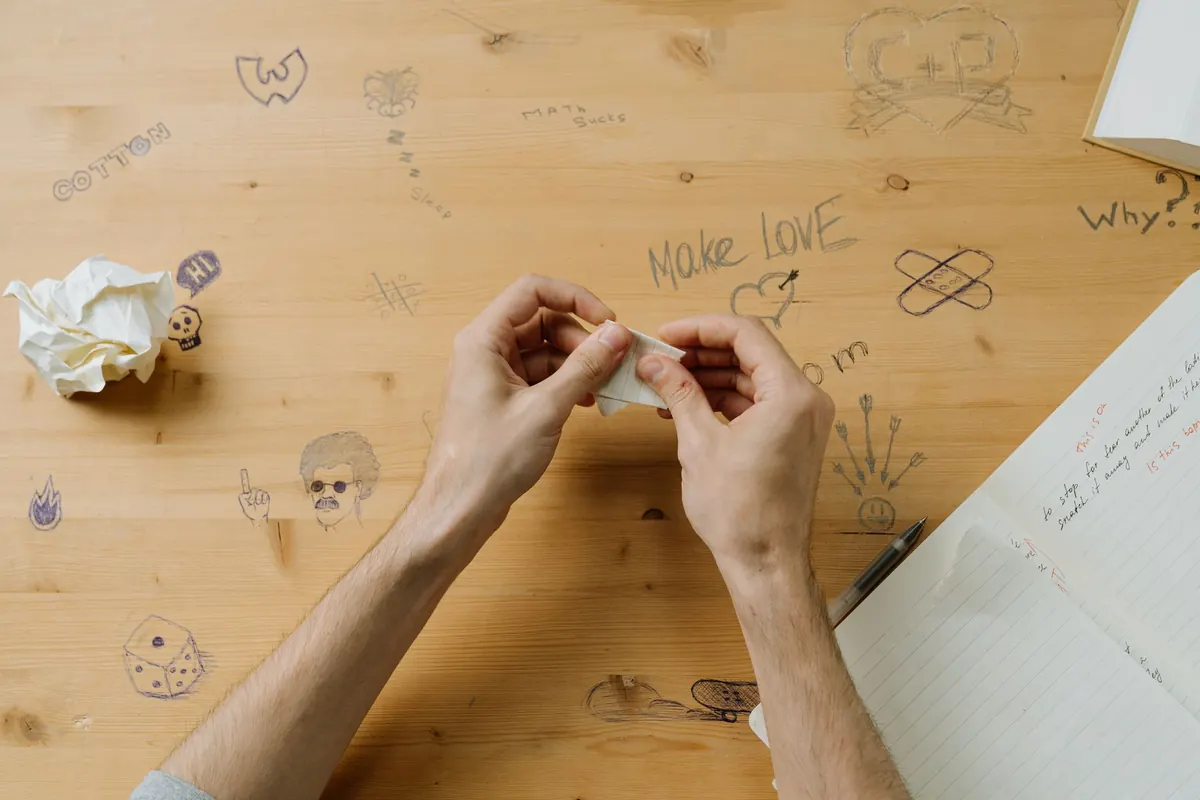
The notebook is somewhere in the flat. You know the one — the one with the nice cover, bought in a hopeful mood, filled for four days in a row and then buried under a stack of unopened mail. Most people who quit journaling don't quit because they're lazy or unimaginative. They quit because a handful of small habits made the practice feel like homework, and homework is easy to skip.
Each of those habits has a fix that takes about a minute to learn. Below are the seven mistakes that end most journaling routines, what each one looks like in real life, and what to do instead. You don't need to fix all seven at once. Find the one that sounds most like you, change that, and let the rest wait.
There's a particular kind of person who owns six blank notebooks and not one filled one. The reasoning is always the same: this one is too pretty for a bad day, I'll start properly on Monday, I should get a better pen first.
A notebook is not a practice. A cheap exercise book from the supermarket works exactly as well as a linen-bound one with a ribbon marker, because neither of them writes anything on its own. What matters is having paper within reach when a thought arrives.
Take any notebook you already own. Write the date at the top of the first page and one true sentence underneath it. If you must buy something, buy it cheap and buy it once. Ugly notebooks are easier to be honest in, and honesty is the whole point.
You can spot it in the handwriting: neat, formal, slightly stiff. Then a sentence like "I felt somewhat frustrated today" shows up where "I was furious" would have been accurate. Somewhere in the back of your mind, your mother, your ex, or a future biographer is reading over your shoulder.
That pressure makes entries dull, and dull entries get skipped. State the rule on the inside cover: nobody reads this, including future me, unless I choose to show them. Then write the petty, sweary, ungrammatical version. If a sentence makes you wince, that's usually a sign it's true.
Streaks are motivating until the first missed day. Then the whole project collapses, because in your head the record is already broken. Twelve days become zero, and the notebook goes back under the mail.
Measure something else: how often you come back. Journaling once a week for twenty years beats fourteen perfect days in March. Keep a pen near the bed and give yourself a two-minute floor. On a bad night, write the date and one line — "Tired. Nothing happened. The boiler is still broken." That counts. Often you'll keep going once you've started; when you don't, you've still kept the thread alive.
Many people treat the journal as an emergency room. It fills with arguments, money worry, and the flu, so rereading it feels like walking through a bad month, and the notebook starts to seem like a bad-luck charm.
Write the ordinary too. Note what you ate, the state of the weather, a song you played twice, the receipt you kept for no reason. Aim for three quick lines on a normal Tuesday, none of which need to be interesting:
These entries are the ones you'll actually enjoy reading in two years. They also make the harder pages less frightening to open.
A full page, every day, with a mood chart and a gratitude section and a summary at the end of the week. It sounds admirable in January and it's the reason the notebook stops in February.
Cut it down. Five minutes, timed, and a hard stop when the timer goes. Don't finish the thought neatly — leave the last sentence half-built so you have somewhere obvious to start next time. Some writers do this deliberately; it's an old trick, and it works because a dangling sentence is a much easier invitation than a blank page.
One honest line about a Tuesday in November is worth more than a perfect blank page in a notebook you never open.
If you only ever write, the journal becomes an expensive bin. The value shows up when you look at it occasionally and notice patterns: the same complaint in four different entries, a worry that resolved itself, a person you mention fondly every time you see them.
Try a short review at the end of each month, ten minutes with a cup of tea. Read a few pages, mark one line that still feels true, and ask yourself two questions: what kept showing up, and what do I want more of next month? Don't grade yourself. You're reading for evidence, not for a verdict.
You miss three weeks, so you rip out the blank pages, buy a new notebook, and begin again — and the pattern of starting over is itself the reason nothing accumulates.
Leave the gap. Draw a line, write the new date, and carry on in the same book. A journal with a three-week hole in it is a more accurate record of a life than a shelf of untouched notebooks. If the gap bothers you, write one line about why you stopped. That page will probably teach you more than the twenty around it.
Pick one fix, not seven, and make it concrete:
That's the whole system. It survives bad weeks, deadlines and February, because it asks for very little and forgives the gaps. If what surfaces on the page is consistently heavy and doesn't lift, a conversation with a doctor or therapist is worth more than any notebook — a journal is a good place to put things down, not a substitute for help.
Photo: cottonbro studio / Pexels

Paper journals win on focus and feel; digital journals win on search and backup. Here is how to choose, or combine...

A commonplace book gathers quotes, ideas, and references into one place, organised by subject rather than by date....
A shorter, later-in-the-day version of morning pages for people whose brains do not come online at dawn — ten...

A free notebook for thoughts and ideas.
